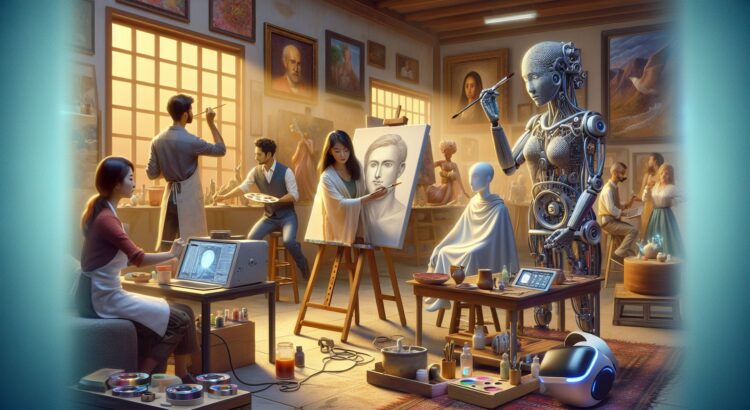
Hey, fellow tech enthusiasts! Today, I want to talk about something that’s been bouncing around in my head like a Van Gogh painting come to life. We’re talking about how Artificial Intelligence is changing creative arts. I know what you’re thinking—AI and creativity? Aren’t they like oil and water? But let me tell you, the way AI is shaking up the arts scene is creating a whole new Renaissance, and I for one am all in. So grab your digital brush, and let’s wade into this colorful conversation.
The Muse in the Machine
Let me start with a bit of a story. A few months back, I stumbled across an AI-generated art exhibit. At first, I was skeptical. “How can a machine understand the subtlety of a Picasso or the emotional punch of a Frida Kahlo?” I wondered. Yet, there I was, standing in front of a canvas that was undeniably moving. The textures, the blend of colors, the eerie familiarity—I was captivated!
AI doesn’t just mimic; it learns. Through machine learning algorithms, AI absorbs patterns and style elements that human artists have developed over centuries. Then, like a digital chameleon, it creates something new and surprising. Companies like OpenAI are leading this space with algorithms that can generate art that challenges traditional norms and perspectives, and the results are, quite frankly, mind-blowing.
The Rapid Rise of AI Composers
Music is another area where AI is breaking barriers and dropping beats—literally. AI-powered platforms can now compose original music, and it’s not just your run-of-the-mill elevator tunes. Think film scores or experimental music compositions that are as complex as anything a human could dream up.
One of the most buzzworthy examples is AIVA (Artificial Intelligence Virtual Artist). This algorithmic music maestro has been scoring music for films, video games, and even advertisements. AIVA even became a registered composer in its own right, which sounds like a sci-fi plot twist but is very much reality.
But here’s where it gets even cooler. Imagine you’re a budding musician, but theory isn’t really your strong suit (I hear you—music theory was my academic Everest). You could collaborate with AI to flesh out compositions, make them more complex, or even explore sounds and genres you’ve never ventured into before. Like having Mozart as your backup band!
Challenges on the Canvas
Not all is rosy in this digital paradise. Let’s face it—tech comes with its own set of problems, and AI in the arts is no exception. One big issue is the ethical and copyright mess that gets tangled up in this new frontier. When an AI creates something, who owns it? The coder? The program? The company?
This lack of clarity is sparking debates that could go down in history next to “Is Pluto a planet?” People like Elon Musk and organizations such as the Creative Commons are pushing discussions forward, but we’re still in the early chapters of this saga.
Then there’s the question of quality. With AI able to generate artworks and music almost instantly, could we see a flood of mediocre content? The market could become oversaturated, causing truly exceptional pieces to get buried under digital noise. I think of it as a double-edged sword; more content could also mean more diverse expressions and innovation.
A Big Shift in Creativity
Let me speculate a bit here. Imagine a future where AI and humans create partnerships in the arts. You might wake up one day, ask your AI assistant for a morning tune, and receive a freshly composed symphony tailor-made for you. Artists might use AI to test boundaries they couldn’t have imagined, creating new styles that would become tomorrow’s classics.
Moreover, AI might democratize the art world, making it more inclusive than ever. You don’t need to be a virtuoso to create evocative pieces; armed with an idea and a few digital tools, anyone can become the next David Bowie or Banksy (minus the anonymity, perhaps).
Wrapping It Up
As we stand at the edge of this new Renaissance driven by AI, we need to engage with it responsibly and creatively. This isn’t just a fad or a tech trend that’ll be buried in the pile of forgotten ideas. It’s a fundamental shift in the way we create and consume art.
So the next time you swipe through your AI-generated playlist or gaze at an autonomously crafted piece of art, remember—you’re witnessing the dawn of a creative revolution. And who knows? Maybe your next collaborative partner in art won’t have a beating heart, but it might just have an algorithmic soul!
So there it is, my fellow tech aficionados. The world of AI and creativity is rich, messy, and full of potential. Here’s to being a part of this wild ride! Cheers! 🍻