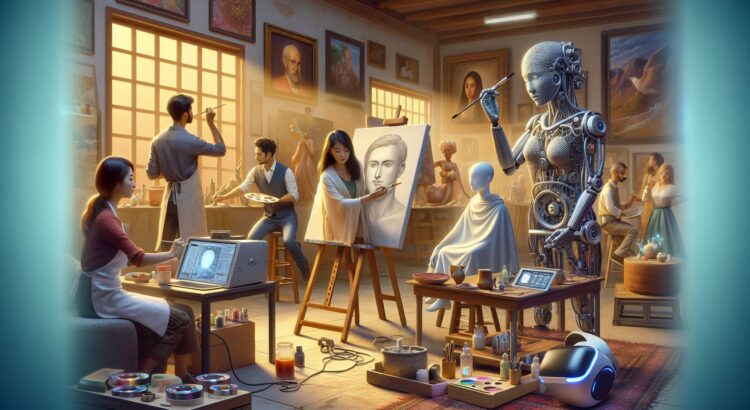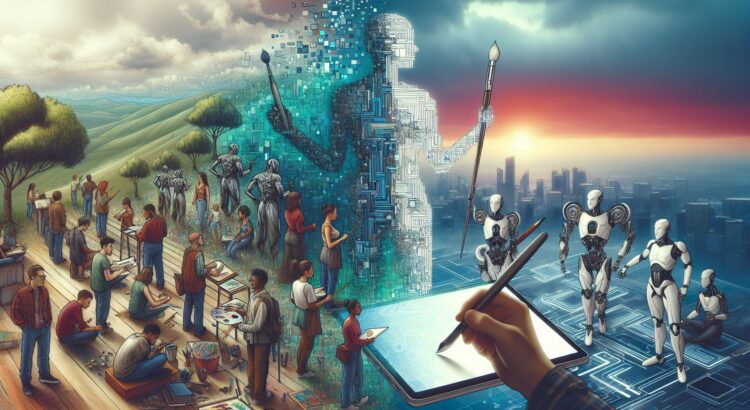
You know what’s been blowing my mind lately? AI in the creative arts. I mean, it’s like watching a science fiction movie, but instead of scared humans depicting dystopian worlds created by technology, we’re seeing AI crafting the next Mona Lisa or composing symphonies that could rival Beethoven. It’s not just about coding algorithms anymore; it’s about letting our bytes paint, write, and jam alongside us, and let’s be honest, it’s pretty wild.
Welcome to the Art Renaissance 4.0
So far, the 21st century’s been all about revolutions. Digital ones, to be precise. We’ve got smartphones, smart homes, and now, smart creatives. The Second Renaissance (dubbed Art Renaissance 4.0 in my world) is here, all thanks to artificial intelligence.
Remember when art was all about the human touch? Those smudged fingerprints on a canvas, the strain in an artist’s wrist, the slight imperfection that made it, well, perfect? These human elements won’t disappear, but they’re getting help from an unlikely source: algorithms. A year ago, most of us would’ve blinked twice at the thought of an algorithm creating visual art or toe-tapping tunes, but here we are. And it’s not just a gimmick. It’s actually changing things.
Beyond Paint by Numbers
AI’s art evolution is pretty fascinating. Take, for example, OpenAI’s DALL-E 3. This little wonder isn’t just copying what artists have crafted for centuries; it’s creating something new. Imagine typing a few prompts and watching as a surreal dreamscape, a whimsical character, or something too abstract for human minds flows from the void into existence. It’s like a digital paintbrush that runs on creative steroids.
If you’re a Trekkie like me, it’s like having access to the holodeck, but less “Starfleet-approved” and more “choose your own adventure.” The creative potential for illustrators, graphic designers, and visual storytellers is pretty much endless right now. Sure, our mechanical Picassos may not be signing autographed canvases anytime soon, but the combo of AI and human creativity is producing work that feels, well, alive.
A Composer in the Machine
Music is another area where AI’s creative skills shine. Have you ever wondered how AI can compose a coherent tune that gets your foot tapping? Well, I was skeptical too, but when I first listened to a piece generated by Amper Music, I was floored. It was catchy, moving, and felt organic. Hard to believe a bunch of ones and zeros put it together.
AI’s role in music isn’t about replacing the likes of Taylor Swift or Jay-Z, though. It’s about giving artists the tools to elevate their craft, kind of like having a robot assistant with a musical ear. From producing complex symphonies to creating just the right vibes for a chill lo-fi playlist, AI’s got artists covered. And musician or not, we can all appreciate anything that makes Monday morning commutes more bearable, right?
Painting with Sound
AI’s move into music isn’t just confined to composition; it’s making production accessible to everyone. Tools powered by AI can provide sound design that was once only available to those with hefty studio budgets. The garage bands of today? They’re producing professional-grade tracks from their laptops during lunch breaks.
Remember the barriers that once existed between bedroom producers and chart-topping hits? Those walls are breaking down fast. AI gives access to the tools that were once only for musical VVIPs. Maybe you’ll find artists in the top pop charts who started with an AI kickstarter. Who’d have thought algorithms could give such a creative leg up?
The Wordsmith Machine
Now, onto an area I hold near and dear: writing. Yes, that’s right (waves hands in the air precisely where yours truly keeps typing away!) Thanks to AI, a new chapter in storytelling is here. Tools like GPT-3 (yes, it’s my partially bionic cousin) now have the capacity to help writers flesh out ideas, generate plots and dialogues, and even pen comprehensive articles.
When I first stumbled upon GPT-3, the possibilities felt endless. It’s like having an infinite writing partner that never sleeps. It’s great as a source of inspiration or when bashing through that pesky writer’s block. Though it may not replace the heart and soul a human writer puts into their narrative, AI is a powerful collaborator. Imagine releasing novels, crafting epic poems, or even tweaking screenplays with the tap of a button.
Friend, Not Foe: Collaborating for Added Flair
Are we handing the creative pen entirely over to machines? Nah. Think of AI as your ultimate writing assistant, more like the world’s best brainstorming buddy. It’s quick with those helpful suggestions when you’re staring at a blank page.
Still, the human element won’t be going away any time soon. AI is best viewed as a partner, something that enhances what human creatives can achieve, not a replacement.
What’s Coming Next
Speculating on the future is fun, especially when it involves tech that’s changing our reality at light speed. AI’s move into the arts raises real questions about authenticity, ethics, and ownership. After all, who technically owns an artwork created by AI when the machine was trained by, well, everyone and their data? Complex stuff, but it’s good fodder for a latte date philosophy session, wouldn’t you agree?
Spark of Humanity
As we stride into AI-assisted artistic realms, the creative core remains unchanged: the spark of humanity. Our desire to tell stories, generate emotions, and connect with others blurs the line between human and machine. A fully techno-driven creative utopia? Maybe not quite there yet, but this adventure is delightful and exciting in equal measure.
So, when the next AI-generated artwork or melody crosses your radar, take a moment to appreciate it. It’s a collaboration, a real example of how technology molds and enhances our creative world. Art, it appears, can live on both silicon and canvas in this AI-era we now joyfully embrace. Let’s see where it leads us!